

Like many failures exposed by the October 7th War, this too was foretold and ignored.
A new State Comptroller’s report on Israel’s domestic weapons-production capabilities and their impact on the war, is one of the clearest institutional admissions yet that Israel entered the largest war in its modern history with critical parts of its domestic weapons-production ecosystem hollowed out. Production lines had atrophied. Raw-material capabilities had disappeared entirely. Emergency stockpiles and surge-production planning were inadequate. And the political system largely failed to impose a coherent national policy around “blue-and-white” defense manufacturing before the war began.
After the Hamas-led October 7 attack triggered a large-scale regional war, Israel suddenly faced multiple pressures at once: soaring global demand for weapons (already strained due to Ukraine demand), disruptions in international shipping and manufacturing, and restrictions on arms sales from some countries that Israel had long viewed as dependable partners.
This was not discovered on 7 October, 2023. Previous Comptroller audits in 2007, 2012, 2014 and 2020 had already warned about ammunition readiness, essential production lines and Defense Ministry planning. By 6 October, 2023, the IDF still had not mapped and prioritized weapons whose production had to be preserved in Israel. The vulnerability was written down. It was not closed.
The report also documents a governance failure. Before the war, the security cabinet did not hold a comprehensive discussion on the full range of domestic production capabilities Israel needed, nor did it set priorities or a funded implementation plan. Defense Ministry mappings in 2021 and 2022 were approved without IDF participation. They did not fully cover components, raw materials and manufacturing technologies used in Israeli weapons dependent on foreign supply.
By the end of 2023, the Defense Ministry had placed an order for one unspecified weapon in quantities exceeding all orders for that weapon combined between 2016 and June 2023. Production had to be accelerated after the system was already under stress. Prices followed: the Comptroller cites postwar increases of between 25% to 365% for dozens of items used by the defense establishment.
The Penny Drops. Eventually.
Russia’s war against Ukraine triggered a global munitions scramble, driving up demand for weapons, components and raw materials. After October 7, several countries, including some friendly to Israel, imposed embargoes or restrictions on weapons, raw materials, spare parts and components. The report does not name them. The point is structural: allied supply is still political supply. A missile, drone, interceptor or armored platform is only as sovereign as its weakest foreign-dependent component.
The Ministry of Defense began additional mapping only after the war began, this time with IDF participation. New directives were issued. Budgets were allocated. Industrial independence became a higher priority. That is progress. It is also the pattern the report exposes: Israel recognizes structural risk after battlefield pressure forces the issue.
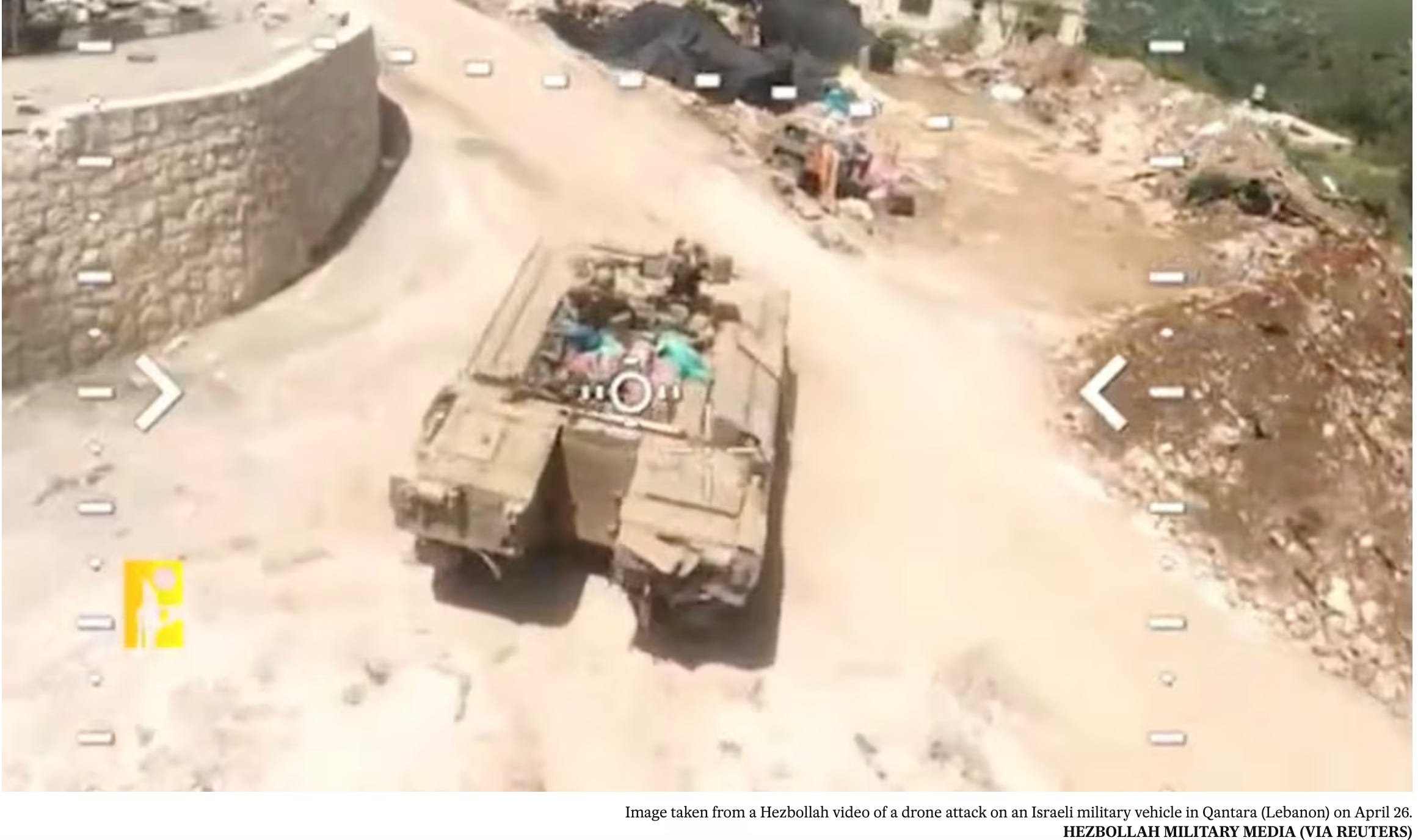
The latest proof point is southern Lebanon. Hezbollah’s use of fiber-optic FPV drones —which have already killed several soldiers in Lebanon and hit IDF bases inside northern Israel—is a live test of whether Israel can convert known threats into mass-produced, locally deployable countermeasures fast enough.
Not So Fast
Fiber-optic drones are especially difficult to counter because they do not rely on radio signals vulnerable to conventional electronic warfare. They are controlled through a spool of cable thin as dental floss by an operator up to 10km away.
Israeli responses so far range from fishing nets and camouflage to interceptor drones, computerized rifle sights, lasers and new local detection systems. But these are improvised stop-gaps to threats that were known years. Nets over vehicles are not embarrassing because they are primitive; battlefield adaptation often is. They are embarrassing because the FPV revolution has been visible since Ukraine, and Israel is still racing to distribute answers under fire.

The conclusion is that the gap is not only technological, it is cultural: a defense establishment with immense technical capacity, but a slow conversion rate between known threat, funded requirement, industrial production and fielded capability.
The immediate lesson is not autarky. Israel cannot manufacture everything at home, and it should not try. The state must decide which systems, components, raw materials and countermeasures cannot be externally vetoed or delayed, then fund them before the next crisis.
That means more than interceptors and missiles. It means optical sensors, acoustic detection, micro-radars, anti-drone ammunition, ruggedized soldier sights, batteries, motors, secure chips, industrial robotics, repair capacity and rapid manufacturing. It means treating the defense-industrial base not as a procurement back office, but as an active combat system that must support rapid fire battlefield innovation cycles increasingly defined by the speed of software.
Excellent piece, as usual.
Well written. Also worth noting who was the Prime Minister who ignored these repeated threat assessments.