

Pax Silica, Declared in Stone, Written in Air
The United States and Israel this week unveiled what they called a new strategic framework for artificial intelligence and critical technologies, signing a joint declaration under the banner Pax Silica, a U.S.-led coalition aimed at building a “coalition of capabilities” among leading tech nations (but which includes Qatar) to reduce dependency on hostile actors — especially China — in critical supply chains.
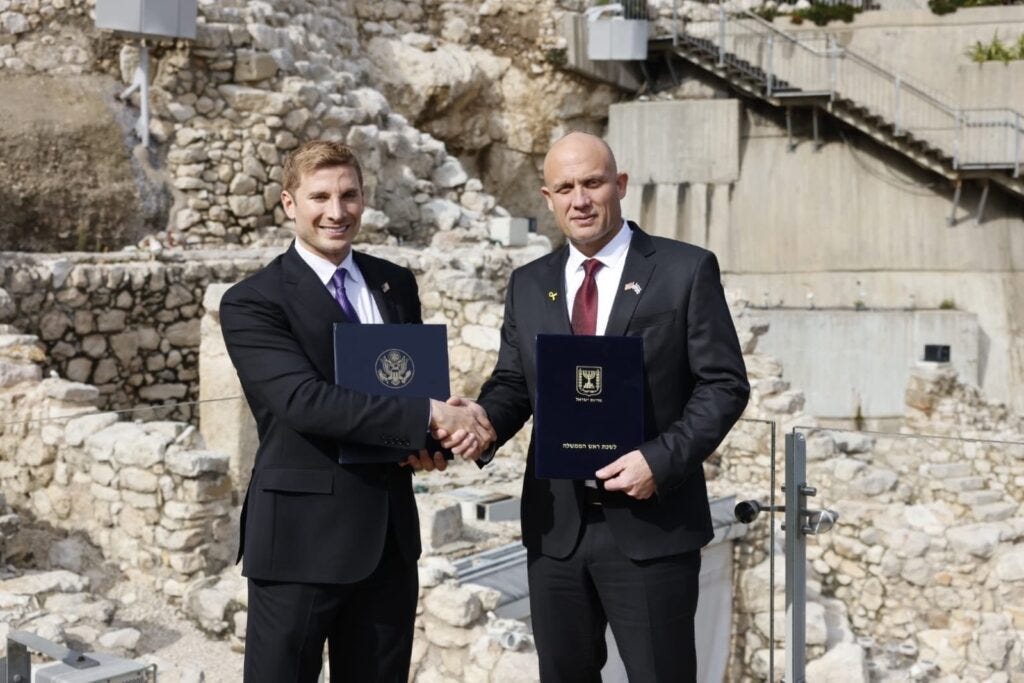
The setting was deliberately theatrical: the City of David in Jerusalem, surrounded by archaeological ruins more than three millennia old. The message was continuity—ancient resilience meeting modern power.
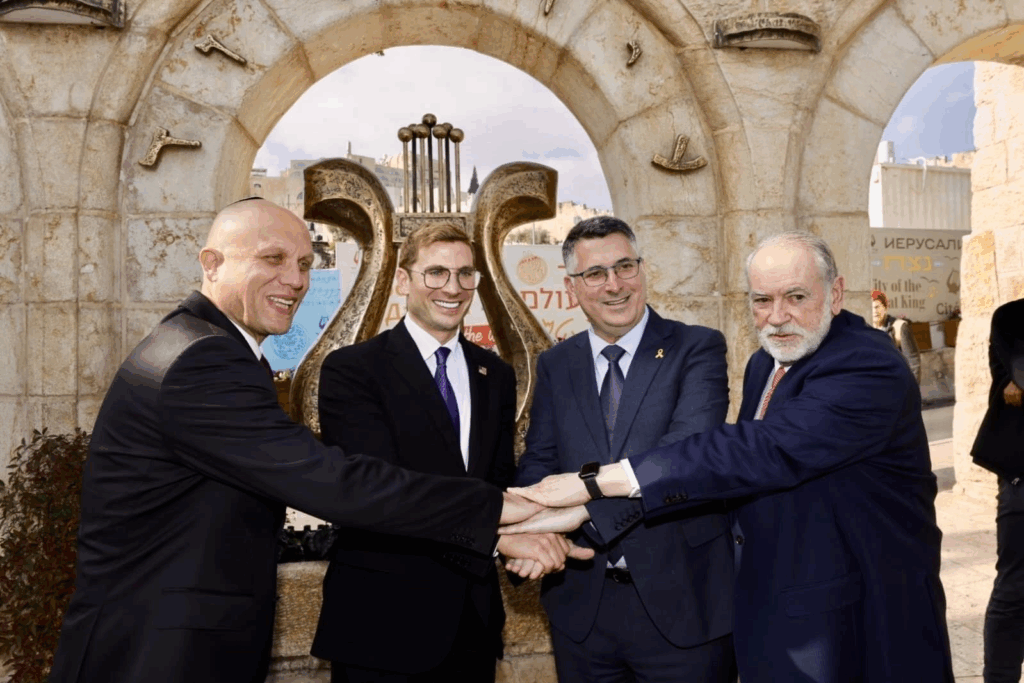
The document signed, however, was not a treaty, a funding agreement, or an industrial plan. It was a joint declaration of intent, committing both governments to “deepen cooperation” on artificial intelligence, semiconductors, space, robotics, energy, and other “critical and emerging technologies,” while promoting secure and trusted supply chains and expanded research, investment, and commercialization.
In diplomatic terms, it was a signal. In policy terms, it was thin.
The declaration creates no new institution, allocates no funding (“Nothing in this statement commits the participants to the expenditure of funds”), and names no projects. It does not establish a joint secretariat, but rather a Joint Economic Development Group as “the primary steering committee to provide strategic direction on the implementation on areas of cooperation.”
There are no timelines, milestones, or benchmarks. Nothing in the text binds either side to act, beyond a general aspiration to cooperate more closely across a very wide technological frontier.
This matters because the problems Pax Silica claims to address—AI leadership, semiconductor resilience, energy security—are not solved by alignment statements. They are solved by hard choices: procurement commitments, export controls, investment screening, research restrictions, and expensive infrastructure build-outs. The declaration gestures at “protecting sensitive technologies,” but does not define what is sensitive, who decides, or how that protection will be enforced.
Artificial intelligence, the centerpiece of the initiative, is treated more as an abstraction than as infrastructure. The declaration speaks of advancing AI research and innovation, but says nothing about compute capacity, shared facilities, data access, or procurement—the bottlenecks that now define global AI power. There is no reference to joint supercomputing resources, cloud access, or coordinated investment in the physical stack that makes advanced AI possible.
The same pattern repeats across other domains. Semiconductors are invoked without specifying whether cooperation is focused on design, manufacturing, packaging, materials, or workforce. Space is framed as “the high ground” without distinguishing between civil, commercial, or security use. Energy is described as a “base layer,” but without any indication of whether the focus is grids, storage, nuclear, renewables, or industrial power for compute-intensive systems.
Perhaps most conspicuous is the absence of money. There are no figures, no funding vehicles, no public-private instruments, and no procurement pledges. A strategic partnership without capital is not strategy; it is branding.
The rhetoric surrounding Pax Silica goes further, presenting technological strength as a pathway to peace. That is a comforting formulation, but an incomplete one. Building trusted supply chains and technological blocs also entails exclusion, friction, and retaliation. None of those trade-offs appear in the declaration, which avoids naming adversaries, chokepoints, or enforcement mechanisms.
Pax Silica may yet become meaningful. Declarations often precede substance. But at present, it functions more as a narrative wrapper than an industrial framework—a way to signal unity and ambition without committing to the costly, contentious work that real technological sovereignty requires.
When the ceremony fades and the cameras leave the ruins, what changes? Who is in charge, what is funded, and what gets built? Until those questions have concrete answers, Pax Silica remains a declaration carved in stone surroundings, but written in air.
This was a good piece, as usual.
Do you have any thoughts on this Fort Foundry One that Globes is reporting on today?
https://en.globes.co.il/en/article-us-tech-park-in-negev-may-have-nuclear-power-plant-1001533004