

This Is How the World Ends
In 2026, a satellite can change orbit without being seen, an order can arrive in a general’s voice without coming from the general, and a strike plan can be drafted, approved, transmitted, and launched faster than a human can prove it’s a fake.
That is the throughline of the December 2025 Defense Tech Week newsletter (Hebrew), which lists transformative military applications that emerged in 2025 across Space, Defense, and AI.
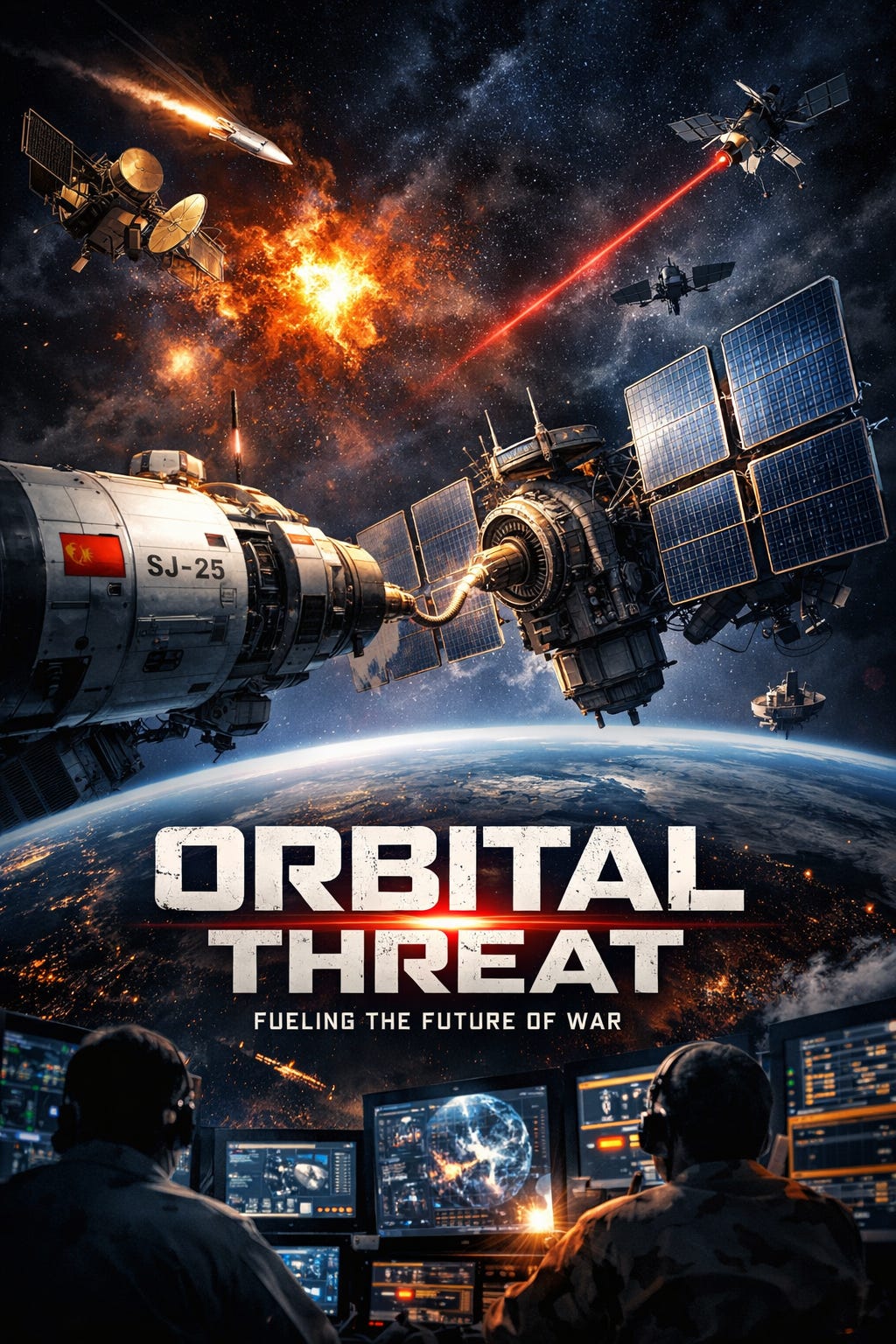
Start in orbit. China’s Shijian‑25 spacecraft demonstrated orbital refueling in geostationary orbit, where communications, missile‑warning, and nuclear command satellites operate. Fuel has always been the limiting factor in space: once a satellite runs low, its behavior becomes predictable and its lifespan finite. Refueling breaks that constraint. A satellite that can top itself off can loiter indefinitely, shift position unexpectedly, or follow another satellite for inspection or interference.
At the same time, both China and Russia are deploying stealth satellites designed to be difficult to track. The newsletter describes systems with variable radar cross‑sections, meaning their surfaces and orientations can be adjusted so that radar signals sometimes bounce back clearly and sometimes scatter or disappear entirely. Ground stations that rely on radar to know where an object is instead see something flicker, shrink, or vanish. Russia’s Mozhayets satellite compounds the problem by being optically dim—too faint for many telescopes to track reliably. Space, once crowded but observable, is becoming more like urban warfare: unpredictable, dangerous, with rapid adaptations in tactics.
The United States is accelerating from a different direction: automation. The Department of War’s rollout of GenAI.mil replaces experimental chat tools with a mandatory, Google‑powered system. It speeds things up. The tradeoff is fragility. When AI systems generate plans at machine speed, errors propagate before humans can interrogate assumptions. The system does not need to be malicious to be dangerous—impersonating your enemy and issuing his orders is the Holy Grail of combat— it only needs to be wrong faster than correction is possible.
Meanwhile, reality itself is becoming unreliable. AI voice cloning has enabled impersonation of senior U.S. officials. Human authentication based on voice recognition is no longer reliable, even among experienced, security‑aware officials.
Deepfake videos—cheap to produce, increasingly convincing—have already reached tens of millions, including a fabricated coup video in France that spread faster than platforms chose to intervene. These are often reported as misinformation problems. In war as in life, timing is everything. A false order or surrender broadcast does not need to last long, it only needs to go viral enough to disrupt command decisions.
Individually, none of these developments end the world. Together, they change how wars begin. When satellites can move without being seen, orders can be issued without authors, and decisions are made faster than verification allows, escalation could come very quickly.
They need to hurry up, perfect these systems and end it then.