

Embedded, not sovereign
At the start of 2025, the dominant narrative was Israeli isolation: sanctions, boycotts, capital flight, brain drain, pariah-state dynamics. By Q4, the opposite materialized. Oracle, Nvidia, and other major Western tech firms tripled down on Israeli R&D. Investments and Exits soared. Gulf capital deepened. Defense procurement accelerated. AI collaborations flourished.
Startup Nation went to war in 2023. By the end of 2025, Israel became more embedded in Western and regional infrastructure, not less.

But that Silicon Shield is heavier and more brittle than anyone here admits.
This newsletter tracked one signal all year: Israel is both embedded and exposed—locked into critical Western tech, AI, and defense systems, while vulnerable to the politics, capital, and compliance structures that govern those systems. That duality—entanglement without autonomy—will decide who sets Israel’s strategic terms for the next decade: Israeli institutions, or foreign boardrooms whose interests may diverge, and whose circular economics may not survive the next geopolitical shock.
In 2026, I’m raising the bar for paid subscribers—more original reporting, sharper analysis, and earlier signals.

3 Structural Shifts Defined 2025
Shift 1: Built In, Locked In
Israel didn’t become peripheral to Western semiconductors and AI—it became structural. As laid out in:
Israel now sits on the critical path for global AI—chips, data centers, infrastructure, and defense systems. That brings both leverage and dependency—but not in equal measure, and not in Israel’s control. We’re critical to the world’s most important company NVIDIA, which is great. But if something bad happens to that company, that’s not so great. I worry about this.
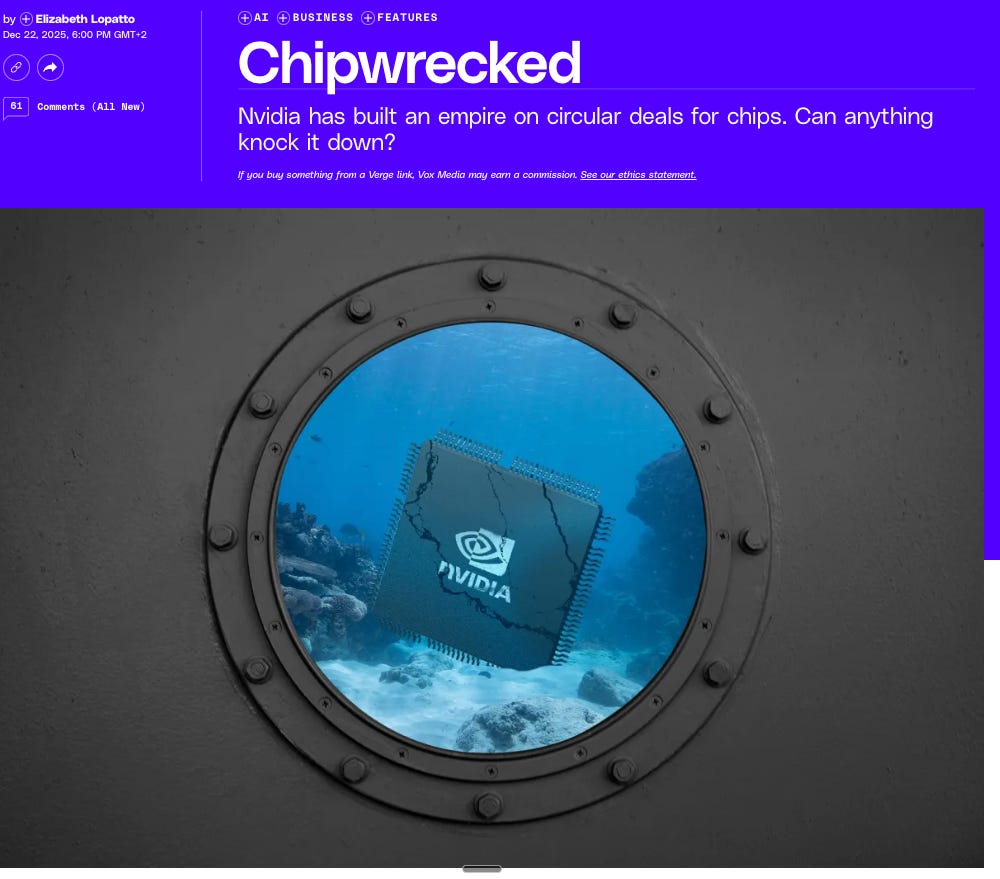
At this point, our future depends on roadmaps set in foreign boardrooms, enforced by foreign regulators, and vulnerable to foreign political risk. Oracle’s next Israeli data center may protect domestic compute sovereignty—or Oracle will collapse under its own circular economy weight. Long Live NVIDIA and all, but putting so many AI eggs in Jensen Huang’s basket could go bonzai.
Shift 2: Boards Set Borders
Foreign VC first investments dropped from 60% to 49%. Israeli VC struggled to raise new funds. European LP’s divorced Israeli tech. The Gulf is spending its way to AI supremacy. Israel, not so much.

In 2025, who funds you wasn’t just a financial question—it was geopolitical. Valuation decides exit. Sovereignty decides survival. Whether Israeli AI or defense startups align with European regulation, American cloud policy, or Gulf political priorities now depends on who sits on their cap tables and boards. The blurred line between commercial and defense tech is no longer theoretical, it’s operational. Most founders think “valuation.” The smart ones think “sovereignty.”

Shift 3: Super-Sparta As Operating System
Israeli tech stopped treating war as disruption and started engineering around it. Companies now design staffing, financing, and products assuming reservist call-ups, recurring shocks, and permanent mobilization. Foreign investors initially fled but they’re beating a path back. Combat-proven products, stress-tested management, “Founders Under Fire”—that’s the moat driving record-high Israeli tech activity.
The cost: Human capital stretched thin, capital tilting toward defense, liberal institutions under pressure from illiberal government, and tech employees who do all the military service, pay all the taxes, and get only more service and taxes as thanks.

Super-Sparta works under pressure. It fails over time. You can sprint on inherited infrastructure. But sprints don’t build futures. This has a stark effect on Israel’s most precious resources: the brains and hustle of its tech workforce. Doubly so in the all-important discipline of AI. Talent diverted from foundational R&D to short-cycle defense applications creates great middleware, but very little sovereignware.
Looking Ahead: 2026+VAT
2026 will clarify whether Israel is a strategic player or a sexy subcontractor—critical to the West, yet unable to shape its own strategic path. Here’s what I’m looking out for:
1. Permission To Compute?
Right now, Israel’s best AI work runs on ChatGPT, Claude, Gemini, Cursor, AWS, Azure, Google Cloud, NVIDIA chips, and the list goes on. That’s fine until Washington, Redmond, or Riyadh decides it isn’t, for whatever reason.
The 2026 question: Does any Israeli institution operate meaningful AI training capacity without needing permission from hyperscalers? If the answer is still “no” by December 2026, then “AI powerhouse” means talent exporter, not sovereign innovator.

2. 2023 Redux: Coalition Risk as Market Risk
Gaza isn’t settled. Neither is Lebanon. Syria looks promising until Turkey decides it doesn’t. And what have the Iranians done with those 400 kg of Highly Enriched Uranium? Don’t even get me started on the West Bank. Elections are likely October 2026. That returns Israeli tech to pre-war 2023: coalition overreach, judicial reform battles, government treating institutions as enemy. Foreign investors learned in 2023 that Israeli dysfunction is material to corporate decisions. Super-Sparta proved the ecosystem functions under external stress. It didn’t prove it survives internal institutional collapse.

In 2023, tech leaders spent more time fighting judicial overhaul than anything else. That energy wasn’t recoverable. If 2026 elections destabilize the coalition, same dynamic repeats: urgent displaces strategic. Super-Sparta proved the ecosystem can survive external shocks. It hasn’t yet proven it can survive internal chaos.
Signals to track: Do VCs build political risk clauses into term sheets again? Do acquirers demand new governance warranties? What if U.S. procurement officers get White House signals that Israel is liability, not ally? If 2026 looks like 2023 politically, 2025’s capital and partnerships won’t hold automatically.
3. Running on Fumes: The Human Capital Depreciation
Israel runs on scarce, high-end technical talent. That pool is aging, stretched, emigrating, politically and demographically squeezed. Does the political system treat human capital formation—military service inequality, education quality, research capacity, quality of life—as strategic priority? Or does another year pass where defense mobilization and culture wars consume political bandwidth while civilian infrastructure atrophies?

Super-Sparta works for companies needing resilient execution. It fails for nations and institutions needing long horizons and stable staffing. When your best people spend 200+ days per year in reserves, that’s not a productivity hit—it’s a constraint on what problems your ecosystem can solve. You get excellent at rapid iteration. You get worse at patient capital formation, basic research, deep infrastructure work that takes years to pay off.
Israel Delivers No Matter What*
Israel’s world-beating edge didn’t emerge in 2022 or 2023. It was built on investments made decades ago—in science, national service, research culture, and open institutions. But that inherited capacity is depreciating, faster than it’s being replenished. Super-Sparta accelerates depreciation by pulling talent toward near-term defense priorities and away from patient R&D. You can run on inherited capacity for a while. But decline doesn’t announce itself with crisis. It shows as gradual competitive loss that becomes irreversible before it becomes obvious.

📬 Thank You
Thank you for challenging, correcting, and sharpening this work all year. The best parts came from your pushback, insights, and willingness to test these theses against your own deals and ideals.
Very good piece. I’ve really enjoyed your insights this year, looking forward to more of your writing in 2026.
There are compelling reasons why Nvidia’s valuation needs to be maintained beyond Israels own needs. Much rides on this. Also does the Gulf have the intrinsic talent to exploit AI or are they mostly going along for the ride? A year of $60 oil may help us answer this question.